Finding growth in a business that already had the equipment
Diadochi Capital · Private equity summer associate · Summer 2025
-
Diadochi Capital is a private equity startup: a small, newly formed firm building its first portfolio rather than deploying an established fund. I joined as a summer associate and worked on its first acquisition.
-
At a large firm a summer associate gets a slice of a process that already exists. Here there was no template, no library of past deals, and no one to hand me a format. The founder and I were the team. I was doing industry research, building the growth thesis, and working buy-side diligence on a live transaction, sometimes in the same week.
-
I came in on the financing side, building the materials that went to lenders on a deal being done under SBA rules that had just changed. That work was assigned. What wasn't assigned was everything that followed: I built the acquisition strategy for the sector, and then the growth strategy for the company once it closed.
The Problem
The company had thirty years of reputation, a large floor, and a full set of equipment. What it didn't have was enough work coming through the door. Orders had slowed, and the constraint on growth wasn't capability or capacity. It was demand.
That matters because it inverts the usual answer. When a business wants to grow, the reflex is to add: more equipment, more capability, more capex. Here, adding would have made the problem worse. The machines already sitting idle were the asset. The question was how to fill them.
What I built?
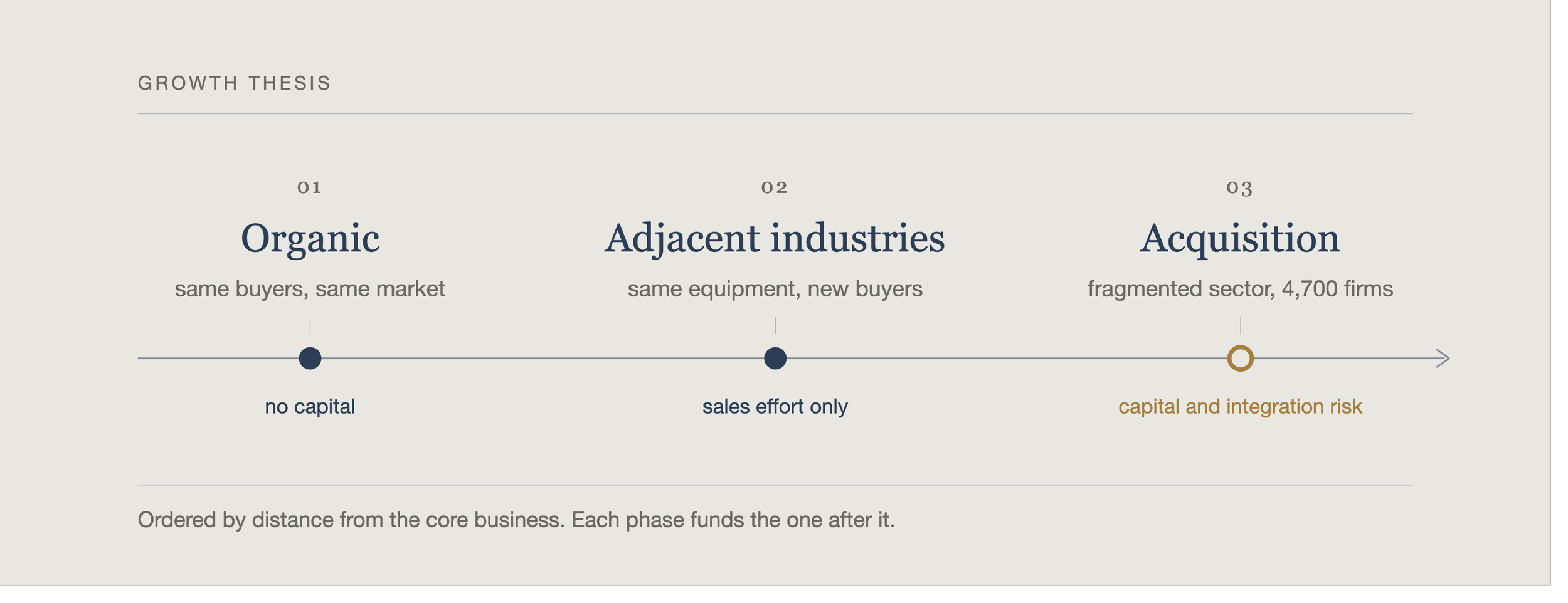
I built the growth thesis in three phases, ordered by how far each one sat from what the business already did.
Phase one, organic
Get more volume from the market the company already served and already had a reputation in. No new capability, no new buyer type, nothing to learn. The fastest revenue available, and the cheapest.
The Hard part: Not enough order coming in, marketing seemingly slowing down in the region.
Phase two, organic into adjacent industries
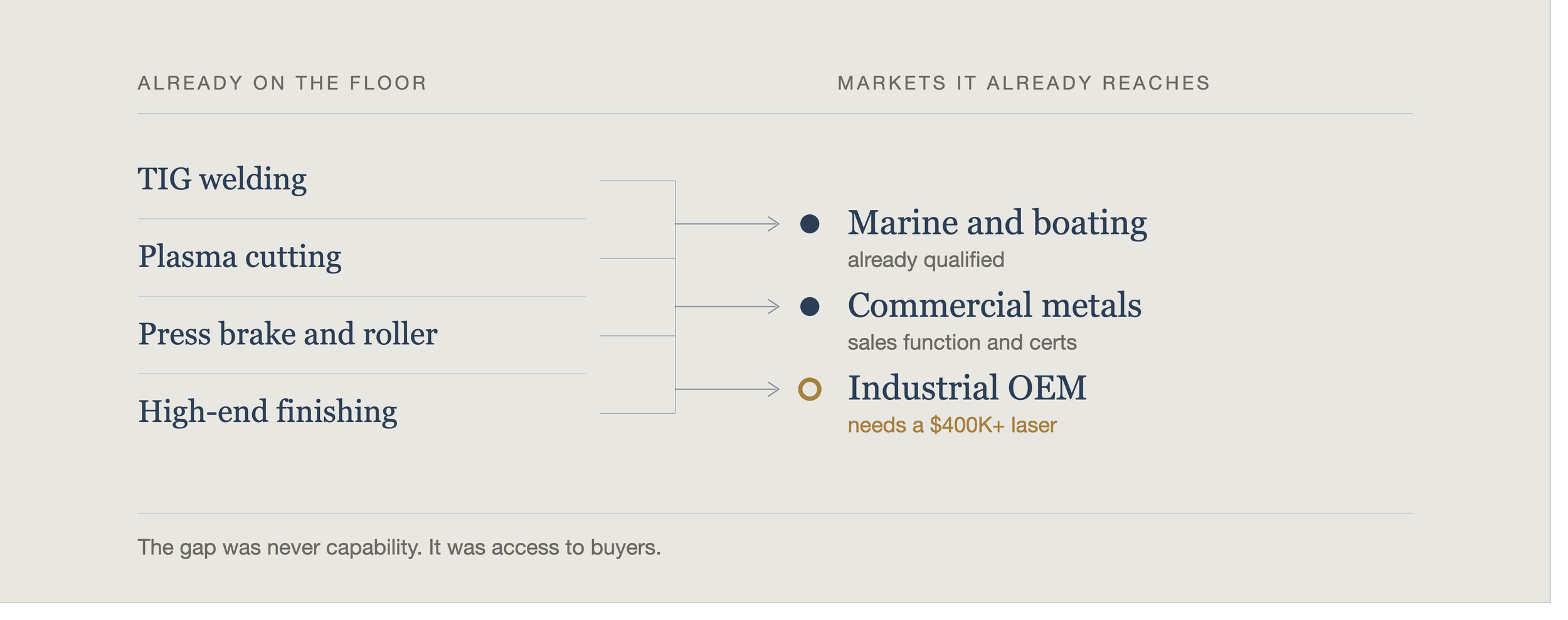
Take the same equipment and the same skills to buyers in different sectors. Marine was the clearest fit. Boat railings and deck hardware are curved, polished, TIG-welded stainless, judged by eye because they're visible parts. That is the same job as an ornamental gate with a different customer attached. Then commercial and institutional construction, where miscellaneous metals packages are routinely subcontracted. New buyers, existing capability.
Phase three, acquisition
The sector is extremely fragmented: roughly 4,700 firms, average revenue near $2 million, no national player. Strategics and PE platforms were already consolidating it. Once the first two phases had proven the shop could run at higher utilization, buying revenue and buying regional access becomes the way to scale past what one facility can hold.
Thinking Behind it
The sequence isn't arbitrary. Each phase is a different answer to the same question, which is where the next order comes from, and they get progressively more expensive and more uncertain.
Phase one is the cheapest possible demand: people who already know the company. Phase two costs sales effort but no capex, because the capability audit showed the equipment already qualified for those markets. Phase three costs real capital and carries integration risk, so it earns its place only after the first two have shown the operation can absorb more volume.
That ordering also meant the plan could fail cheaply. On a first acquisition with a debt-financed structure, a phase that doesn't work should cost a quarter, not the thesis. So the expensive move sits last, funded by what comes before it, rather than first on conviction.
One detail decided the order inside phase two. Boat building runs steady and doesn't move in lockstep with construction, so marine work fills the production gaps between architectural projects. The cheapest expansion available was also the only one that smoothed the demand cycle that had caused the slowdown in the first place.
Impact
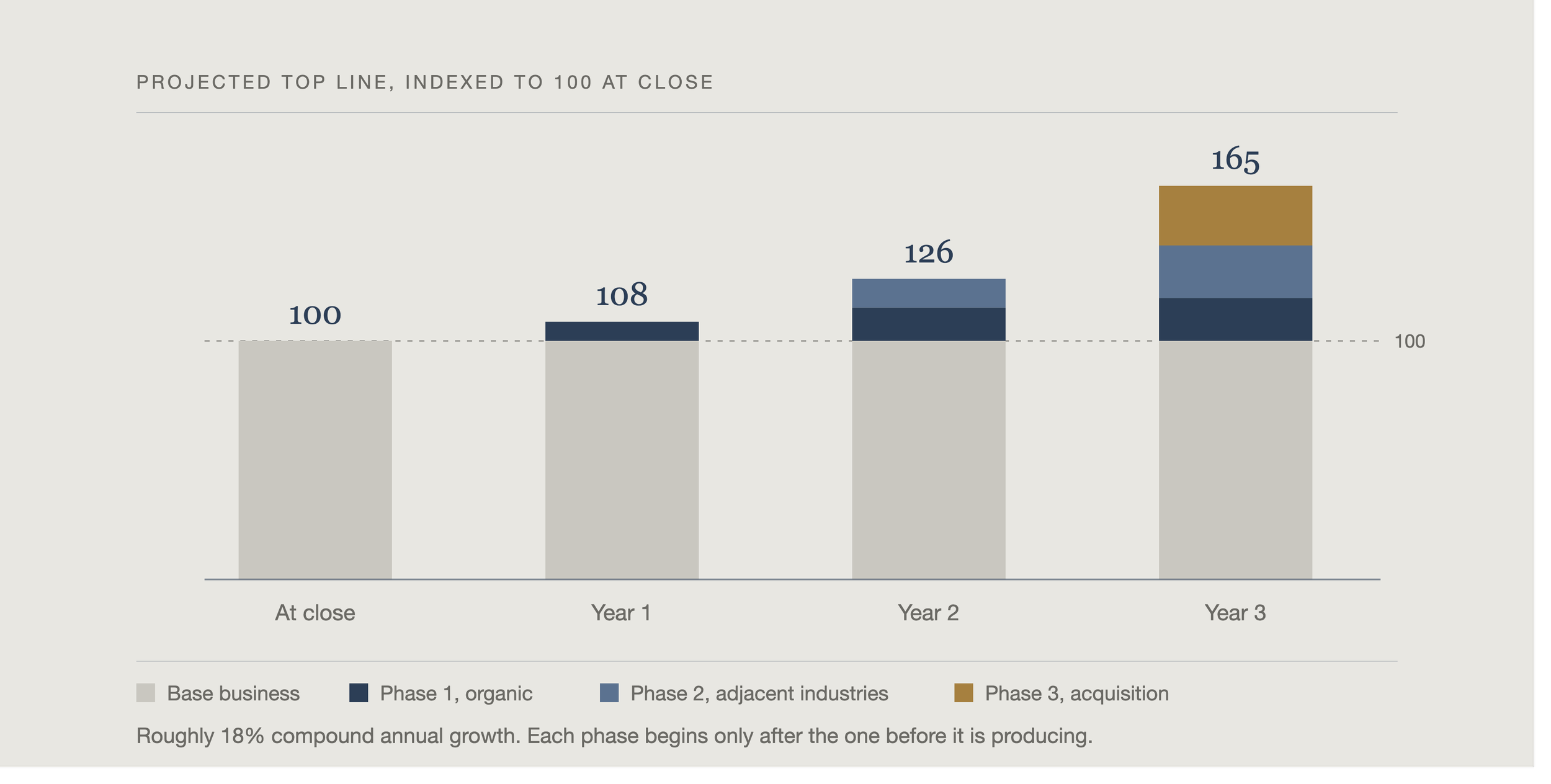
The roadmap was presented to the deal team and portfolio leadership and became the company's growth plan, with the models projecting more than 18 percent top-line growth over three years. The first two phases required almost no capital, since they ran on equipment that was already installed and already underused.